7 lessons solo survival in Rust teaches from a 14-day run
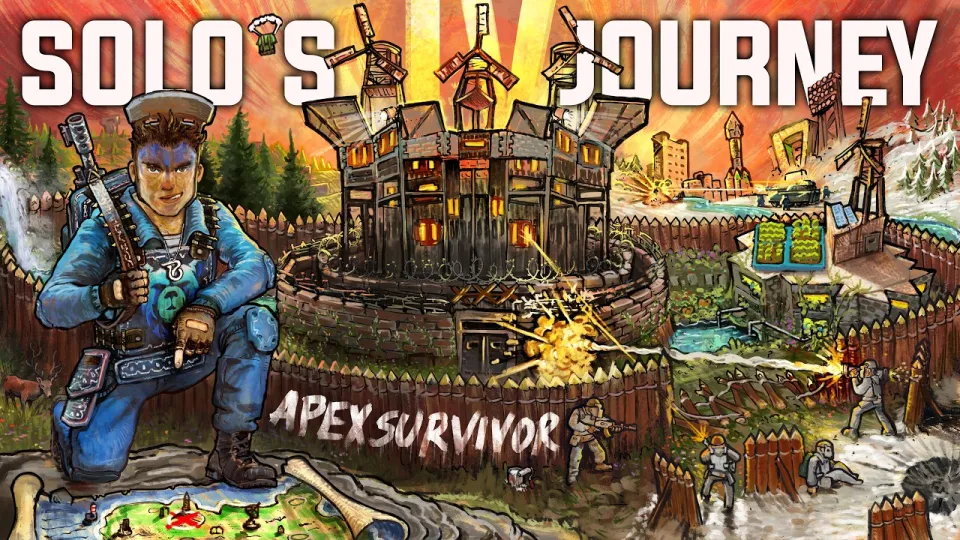
Video: Rust - A Solo's Journey IV: Apex Survivor (Movie)
Want articles like this for your own video to promote it on YouTube and Google? Order them through the Telegram bot @sat_sit_bot. Articles with your video embedded are written and posted by the bot itself — on popular topical sites (no ads). Free trial — 50 articles.
· based on the channel Blooprint
Key takeaways
- Blooprint's "A Solo's Journey IV: Apex Survivor" covers 14 days of solo Rust survival in a single movie-length video.
- The run is split into 12 numbered chapters plus an intro and ending, with a companion tracker site for timestamp-based progress.
- Solo Rust means no clan backup: every farm run, raid and defense is handled by one player.
- A solo wipe rewards low-profile bases, cloned crops and horses, and careful timing around monuments like Oil Rig and Cargo Ship.
- The video was filmed and edited by Blooprint with over 300 hours of editing work behind the final cut.
Rust solo survival is about turning a single player's limited time into a stable base, a working farm and enough gear to survive raids alone. Blooprint's "A Solo's Journey IV: Apex Survivor" documents 14 days of exactly that, and the run's structure — 12 chapters plus intro and ending — makes it a useful reference for anyone playing Rust without a clan. Progress through the challenge can be followed timestamp by timestamp on the Solo's Journey tracker site.
The movie was filmed and edited by Blooprint, with more than 300 hours of editing behind the final cut, and it marks the channel's 2.5 million subscriber milestone. Below are the practical lessons a solo player can pull from a two-week wipe, from base placement to pacing a long session.
1. Treat day one as a base-location decision, not a loot race
The first hours of a solo wipe decide more about the next 13 days than any single fight. A solo player cannot defend a bad location with numbers, so the spawn-to-base route matters: pick a spot with nearby nodes, a reasonable monument and at least one escape path that does not run through open fields. On a long wipe, a modest base in a quiet corner beats a showpiece build on a main road, because every extra wall you can afford later is worth more than the walls you could not finish on day one.
Solo bases also need to be cheap to expand. Starting with a small core and room to add honeycomb, a second loot room and a shooting floor lets you scale without demolishing anything. That is the difference between a base that survives two weeks and one that gets abandoned by day four.
2. Farm with a route, not with hope
Farming is the real engine of a solo run, and the players who last are the ones who farm on a loop instead of wandering. A fixed route — nodes, barrels, a recycling stop — turns an hour of gathering into predictable stone, metal and scrap instead of a gamble. Splitting farm trips into short, repeatable runs also limits losses: if you get caught, you lose one run's worth of resources, not the whole session.
Scrap has its own discipline. Prioritize workbench progression and blueprints you will actually use in the next day, and keep a buffer for trades and repairs. A solo player who spends everything on a single expensive blueprint often ends up with nothing to craft it with.
3. Build a farm base that pays for itself
A working farm base is what separates a two-week solo run from a two-day one. Crops, especially berries for healing and a steady food supply, remove the need to leave base hungry and low on meds. Cloning good genetics and keeping planters running means your healing and food come from inside your walls, which is exactly what a solo player needs when the map gets hostile.
Horses are part of the same logic. A horse turns a long farm run into a short one and gives you an escape option when a fight goes wrong. In the movie's community discussion, viewers single out the farm-base design and the cloning work as highlights, which tracks with how much of a long solo wipe is spent sustaining yourself rather than fighting.
4. Accept that your base shape is a trade-off
A base design that is not the current meta can still be the right one for a solo player. Unusual core shapes and awkward internal layouts slow down raiders who expect a standard floor plan, and they often cost less to build than a fully optimized clan base. The trade-off is convenience: odd layouts are harder to navigate, harder to expand and harder to defend under pressure.
The practical rule is to pick a design you can build and repair alone. If a base needs three people to maintain, it is not a solo base, no matter how strong it looks on paper.
5. Choose fights on your terms and leave early
Solo PvP is a resource decision as much as a skill test. Every fight costs ammunition, meds and armor durability, and a solo player has no teammate to bring replacements. The runs that last are built on short, decisive engagements near your own base or a safe retreat, not on chasing kills across the map.
This is also why monuments like Oil Rig and Cargo Ship are worth timing carefully. They offer high-value loot, but they attract groups and create long, loud fights. Going in early, going in with an escape plan, or skipping them entirely on a bad day is not cowardice — it is resource management.
6. Keep your neighbors in view
On a long wipe, the players around you matter as much as the players you fight. Neighbors who farm the same area, use the same roads and share the same monuments will shape your whole run. Knowing who lives nearby, how active they are and whether they raid tells you when to move loot, when to stay quiet and when to expect company.
Community reaction to the movie shows how memorable neighbor dynamics can be: viewers still bring up the clan that dealt with troublesome neighbors, and the alliance that pulled off a helicopter trick. Those moments are not scripted set pieces — they come from paying attention to the map around you and reacting to what other players do.
7. Pace a long wipe like a project
Fourteen days of solo Rust is a marathon, and the players who finish it plan in blocks rather than grinding until burnout. Splitting the run into phases — establishing a base, unlocking workbench tiers, building the farm, then moving into raids and revenge — gives each session a clear goal. It also makes setbacks survivable: losing a kit matters less when you know what the next phase is.
The movie's chapter structure mirrors this approach, and the companion tracker exists for the same reason. Instead of watching a multi-hour video blind, you can check where the run stands at any timestamp and see how each phase connects to the next.
Common questions about the run and about solo Rust
A few recurring points come up around long solo wipes and around this movie in particular. The length is the first: a runtime close to five hours reads as intimidating until you realize it is a compilation of 14 days, not one continuous session. The second is authenticity — the run is a real wipe, with real neighbors, real raids and real losses, which is why the revenge arcs and alliances land.
The third is whether the approach transfers to a normal player's schedule. It does, with adjustments: shorter daily sessions, a smaller base, and a narrower blueprint plan. The structure — base first, farm second, fights on your terms — is the part that scales down.
Useful links
- Solo's Journey tracker — enter a timestamp and see progress during the challenge.
- Blooprint Vinyl Figure on YouTooz — limited 2.5M subscriber merch, available until Oct. 27, 2026.
- Blooprint mousepads and playmats on Epic Desk — available until Jan. 3, 2027.
- Hires Studio — animated intro.
- Veys — thumbnail art.
Final thoughts
"A Solo's Journey IV: Apex Survivor" is a useful case study because it shows solo Rust as a system rather than a highlight reel: base placement, a self-sustaining farm, selective fights and a paced plan across two weeks. The movie was made by the Blooprint channel, and its chapter structure plus the tracker site make it easy to study one phase at a time. If you want to follow the run without scrubbing through the whole video, open the Solo's Journey tracker and jump to any point in the timeline.
Source: Rust - A Solo's Journey IV: Apex Survivor (Movie) · Markdown version
Questions & answers
How long is Blooprint's A Solo's Journey IV movie?
The video runs close to five hours, split into an introduction, 12 numbered chapters and an ending. It compresses 14 days of solo Rust into a single edited movie, which is why the runtime is so long.
What is the Solo's Journey tracker website for?
It is a companion site built for the video. You enter your current timestamp and it shows the progress of the challenge at that point, so you can follow the run in parts without losing track of what has already happened.
Can a solo player realistically survive a 14-day Rust wipe?
Yes, but it requires discipline rather than raw hours. A cheap expandable base, a self-sustaining farm with crops and horses, careful blueprint spending and avoiding unnecessary fights are what make a two-week solo run possible.
Is the run scripted or a real wipe?
It is presented as a real solo wipe with real neighbors, alliances, raids and losses. Community discussion focuses on genuine moments like a neighbor dispute and a helicopter trick, which is why viewers treat it as a story rather than a staged montage.